Showing posts with label hockey. Show all posts

Tuesday, October 27, 2009

Jersey Destruction: Part 2

Welcome back to the ongoing series "Jersey Destruction". No, it's not about the Carolina Hurricanes giving Martin Brodeur a blown gasket, it's where I mercilessly skewer the jerseys of all 30 NHL teams.

The Central division is rife with fodder for me to mock, so in the spirit of my last post I will show no mercy.

Chicago Blackhawks

You know what I think of when Chicago comes to mind? Native Americans. Okay, not really. Ask ten people what comes to mind when they hear Chicago and their answers will range from "deep dish pizza" to "Sears Tower" to "The Cubs". I'll bet nary a one says "The Blackhawk Tribe." That aside, a pat on the back for avoiding the cartoonish depiction that Cleveland uses, but hey, it's Cleveland. It also appears that the mascot is wearing the NBC peacock in his hair, which is ironic since the Blackhawks didn't televise games for what seemed like a century. The Blackhawks mascot is named "Tommy Hawk" which is all too appropriate considering the town's violent background. Nothing draws Chicago fans like the threat of violence!

Columbus Blue Jackets

Pretty surprising they would select a team name with the word "Blue" in it considering they're in the same division as the St. Louis Blues. So, what comes to mind when you hear "Blue Jackets"? Is it a sale at JC Penney? Is it a rare variety of bee? Nope, it's a Civil War soldier! Did anyone tell these guys to avoid the abbreviation "B.J."? Between the NBC peacock in the Blackhawks logo and the shooting star in Columbus' you have a "The More You Know" PSA.

Detroit Red Wings


On the opposite end of the spectrum from Atlanta, Detroit decided they needed just two colors because they weren't boring enough. Can someone explain this winged-wheel to me. Does it fly? Is it supposed to roll? Do the wings flap against the road as it wobbles around? Is it attached to anything or is it just some kind of lame Transformer? Or maybe it's an angelic unicycle? I mean, isn't the point of the auto industry that it rolls and doesn't fly?

Nashville Predators


There are a lot of animals that could be considered predators, but Nashville was bold and went with one that had incredibly impractical biting apparatus. Dinosaur? No. Jungle cat? Closer. Extinct cat with a severe overbite? Bingo! Pat on the back for ditching the third jersey with the logo that looked like it had a hairball caught in its throat. However, making silver a prominent color just makes us think you're a second place kind of team.

St. Louis Blues

I mean, you're really setting yourself up for failure when your team is named after the official music of the depressed. It must be a thing in the Central Division to add wings to an obscure inanimate object. When I say your logo is a low C, I'm not speaking in musical terms. As a bonus, here is the Blues mascot Louie pictured with former Blues netminder Manny Legace:


I hope you enjoyed this segment of Jersey Destruction. Tune in next time as we head back east!

Monday, October 19, 2009

Mock Expansion Draft

Expansion. The notion pops up every once in a while, exciting the bejeezus out of Kansas City, Las Vegas, Hamilton, and any other city that has gotten a whiff of talks about getting a potential NHL team. However, given the current economic climate it's simply not feasible.

Yet, I was curious, what happens if tomorrow the NHL decides to award two lucky cities an NHL franchise? Then we get to witness the weirdness of an NHL Expansion Draft. Rather than the usual draft of future stars, it's a draft of leftovers.

The basic parameters of an expansion draft are as follows. Each of the existing 30 NHL teams can protect 1 goaltender, 5 defenseman, and 9 forwards. The other option is to protect 2 goaltenders, 3 defenseman, and 7 forwards. I didn't see any teams choosing the latter option, so all 30 teams in my hypothetical chose to protect 1 goalie. Also, rookie players got automatic protection and do not count toward the allotted number. Each new team would then draft 3 goaltenders, 8 defenseman, and 13 forwards in that order.

So, I went through and I conducted the mock draft myself, protecting the players I thought each team would protect, then drafting them in the order I thought they would be drafted. I'm presenting the results broken up into the two hypothetical teams, East and West, in the order I believe the teams would draft them.

After completing this experiment I noticed a number of issues that arise from an expansion draft. First, let's look at the results:

Eastern Team

Goaltenders

J.S. Giguere
Jose Theodore
Jaroslav Halak

Defensemen

Christoph Schubert
Steve Staios
Mike Van Ryn
Martin Skoula
Steve Montador
Hal Gill
Mark Eaton
Peter Harrold

Forwards

Dustin Penner
B.J. Crombeen
Maxim Lapierre
Alexander Steen
T.J. Hensick
Chris Kelly
Tomas Kopecky
Kyle Brodziak
Mike Grier
Pascal Dupuis
Ian Laperriere
Ben Eager
Tom Kostopoulos
Craig Adams
Rick Rypien

Western Team

Goaltenders

Tim Thomas
Vesa Toskala
Martin Biron

Defensemen

Garnett Exelby
Nick Boynton
Milan Jurcina
Mathieu Schneider
Jeff Finger
Lukas Krajicek
Jeff Schultz
Sean O'Donnell

Forwards

Todd Bertuzzi
Eric Belanger
Fredrik Modin
Dominic Moore
Daniel Paille
Radek Dvorak
Scott Walker
Fredrik Sjostrom
Ben Guite
Travis Moen
Torrey Mitchell
Raffi Torres
Steve Begin
Brian Boyle
Fernando Pisani

Obviously, these aren't the strongest teams. The purpose is simply to give the new teams some players to ice while hindering the other 30 teams as little as possible. Then after a few years of toiling in the basement, the new teams should have compiled enough high draft picks to ice some franchise-player talent.

Some observations:

Age? Some of my decisions were dictated by the longevity of a player. For example, both of the top goalies selected were players you would expect to be protected. However, both Boston and Anaheim have goaltenders that are considered their future. In Anaheim's case, Jonas Hiller is considered their present as well. As a GM I would rather hang onto the goaltender that could give me 10 good years rather than 4. This begs another important question; how much does a team's loyalty to a player count? Think Modano. He's on the tail end of a career of great memories in Dallas, but is he worth protecting for 2 or 3 more years?

Contracts? More than a few teams have signed players to bad contracts. Would these teams take this opportunity to potentially unload an overpaid player? Granted, they wouldn't receive anything in return, but they also wouldn't have to pay an overpaid player. In the case of Dustin Penner, I figured the Oilers would see if there were any takers for the big man. Oh, and believe me, I thought long and hard about whether the Islanders would try to unload DiPietro.

Consequences? What happens to a player that does not get protected and they go undrafted. Do they get offended? Would it create a similar atmosphere as when a player gets wind they are on the trade block? There is certainly a risk involved.

The best and worst? I noticed the teams that fare the best are the teams with the most rookies on the roster. The more rookies, the less players that count toward the 9 protection spots. The teams that have the hardest time? Teams with a lot of 2nd or 3rd year players, such as St. Louis. I'm sure B.J. Crombeen isn't a guy they would love letting go, but with the likes of Oshie, Berglund, and Perron taking up valuable spots someone is bound to find themself on the outside looking in.

Most likely to be left out? The agitators and the fighters were the most common names to find themselves out of the mix. There seems to be a pretty good collection of bruisers in the AHL ready to step up, so why waste a slot on one? However, Avery and Carcillo both won spots on their respective teams from me due to their versatility.

Although it will certainly be a while before an Expansion Draft rears it's ugly head, if GM's in this league anticipate growth, they had better anticipate making some tough decisions.

Tuesday, September 22, 2009

How To Be A Better Hockey Fan

Hockey suffers from what I like to call "mainstream obscurity". It's a major sport, a big business, and a household name in our society. Yet, hockey is far from being universally understood or liked. Much is made of how the NHL or other major hockey leagues around the world market the sport. Fans and media alike are often critical of the stances and directions the NHL chooses in order to promote the sport. However, I think the onus is on us as fans to promote the sport as well.

How do we do this? Well, there is no one way and there is no "right" way, but I think there are some simple things we all can do to spread the love for this great sport.

1. Don't Be "That Guy".

Every time you go to a hockey game, or are watching one at a bar there is that one obnoxious, ignorant fan. The type of fan that ruins the game for everyone else and destroys what we are all looking for when we treat ourselves to a game; fun. It's supposed to be fun for everyone, so don't ruin it for others.

Now, I know I can get excited, worked-up, and stressed out but I try to keep it from affecting others. I do my fair share of trash talking as well, but I try to keep it all in good fun. For example, I attended the LA Kings final home game of the 08-09 season. A Sharks fan sat in front of me and ribbed on Kings fans all night, but when it was all said and done, the Kings won the game. Afterward, she looked at me and said "at least the Sharks made the playoffs," to which I replied "enjoy choking in the first round... yet again." She paused a moment, then smiled. No hard feelings, it's all in good fun.

2. Encourage Younger Fans.

I can whine all day about how fans of other mainstream sports don't give hockey a chance or about how they are too unsophisticated to enjoy a "real" sport like hockey, but when it comes down to it, adults have their minds made up. Most adults know what they like and they stick to it.

So get your little brother or cousin or neighbor into it. Take them to a live game for their birthday, show them a game on TV, play a hockey video game with them. Kids are more open-minded and are more likely to give the sport a chance. It's better than wasting your time on your friends who won't give the sport the time of day.

3. Support Your Losers.

Nobody likes a loser, but if you're a true fan then you'll still love them. Go to a game and see them get buried. Watch them on TV and throw popcorn at the set. Wear your jersey out and get made fun of. It's part of being a fan and it makes it that much sweeter when they actually win.

4. Teach People The Game.

Who hasn't sat down to a game with a newbie and heard "what's icing?" or "where's the puck?" Don't laugh at them, help them out. If someone understands the sport they're much more likely to become a fan. Don't just tell them what icing is, explain why it's a rule. It's much easier to remember it that way. Don't just point the puck out to them, teach them how to find it. I like to tell people not to look for the puck. That's like trying to find Waldo. Look at the body language of the players. You can always find the puck when you know how someone acts when they have it.

5. Support Other Teams.

This may sound odd or counterproductive, but don't stop at one team. Be a fan of many teams. It's only more beneficial to the league for you to support as many teams as you want. I personally have an Eastern Conference team, the Hurricanes, and a Western Conference team, the Kings.

Even if your team(s) don't make the playoffs, pick one to support. The more fans following the playoffs, the more attention it gets from hockey outsiders. Our sport is major league sport. Our sport is on television. Our sport is great, so let's make sure other people know why.

***
For fun, I think I'll do a post about how to be an elitist hockey snob. Just to keep the balance of the world right...

Friday, September 18, 2009

What's Good For The Goose...

I remember vividly how angry I was when I saw Brandon Sutter getting his clock cleaned by Doug Weight last season. Sutter was going after a loose puck, anticipating a short-handed breakaway when Weight caught him with his head down and delivered a brutal hit. Sutter had a concussion and his season with the big club was pretty much over.


Jim Rutherford, GM of the Carolina Hurricanes, was incensed with the hit and lobbied for the NHL to do away with hits to the head. Of course, that didn't happen. Debates erupted across hockey message boards on the topic and on the hit itself. Was it legal? Well, no matter how hard it is for a 'Canes fan to swallow, it was a perfectly legal hit. Weight didn't leave his feet. Weight didn't bury his elbow into Sutter's ear. It was a textbook hard hit and Islanders fans let us know it at any chance. Their player was not in the wrong. (Kudos to the Hurricanes commentators John Forslund and Tripp Tracy for their objective evaluation of the hit.)

So why was I angry? I was angry because it was difficult to see a player with such promise, a 1st round pick by my favorite team, and a guy who is already being talked about as captain material have his well-being threatened by an avoidable hit. It was avoidable by both Brandon, who should have had his head up and by Doug Weight who could have decided to lay a less violent hit on Sutter. Now, I don't think Weight had any intention of injuring the kid, just look at his face while they're scraping Sutter off the ice. Nor do I think he should have let up. Hitting is a part of the game. Players, especially young players have to learn to keep their heads up. They can't get away with the stuff they could in juniors any more.

This brings us to yesterday. During a preseason game against the Calgary Flames, the New York Islanders 1st round pick from 2006, Kyle Okposo, had his head taken off by Dion Phaneuf. He was skating with his head down through center ice, just as Sutter was last season, when Phaneuf made him pay the price. Although Phaneuf appears to leave his feet, it was as a result of the hit and not because he jumped into Okposo. Phaneuf was penalized for fighting after the hit, but not for the hit itself. It was another clean hit.


It's an unfortunate irony, but the Islanders are now tasting what 'Canes fans tasted last season. This blog is not meant to rub it in or to laugh at anyone's misfortune. It is to remind fans to look at every play, at every hit, at every goal with objectivity. As much as I wanted to be mad at Doug Weight for his hit, I couldn't be because he did nothing wrong. As much as I wanted to be mad at the NHL for not paying heed to Rutherford's pleas, I couldn't. The rules have been that way for a long time and the NHL isn't about to change them because another person got caught with their head down.

They didn't change them in 2006 when Brian Campbell derailed R.J. Umberger. Players are just going to have to learn not to put themselves in that position and fans are going to have to learn to swallow the bitter pill.

Saturday, August 29, 2009

5 Reasons Why I Love Hockey

The usual line of questioning goes as follows:

"You're a big hockey fan? Did you play hockey?"

"No. Well not organized hockey, anyway."

"Where are you from?"

"North Carolina."

(Long Silence)

"Why do you like hockey then?"

Why do I like hockey then? As if it is not permissible to like something if you haven't played it or didn't grow up around it. I like Italian food and I'm not Italian, nor did I grow up in Italy. Okay, bad example but you get my point.

1) The Subculture. Hockey has a unique flavor that is unlike other sports. You can find a casual basketball or football fan almost anywhere, but if you love hockey, you love hockey. If you're trying to pose as a hockey fan you'll be outed as soon as they blow the whistle and you ask "What's icing?" It's almost like being a Trekkie or a Dog Show person. It's strange and goofy and intense and great.

2) The Regional Warfare. This is a love-hate reason. I hate that small-market, especially southern teams, get so much flack for even existing. Yet, I love it when the small-market team shuts up the haters, even if it's only for a little while. I love when Montreal fans make fun of Toronto for their losing history and I love it when Toronto fans tell Montreal to go celebrate by setting cars on fire. I love it when Sharks fans pick on the Kings for sucking and I love it when Kings fans make fun of the Sharks for always choking in the playoffs. The playing field on-ice might not be level, but off-ice there is more than enough fodder to go around.

3) The Jerseys. There is no other professional sports jersey that is less acceptable to wear in public than a hockey sweater. People wear baseball, basketball, football, and even soccer jerseys all the time. However, if someone wears a hockey sweater in public they look like a total dingus. Baggy sleeves, ill-fitting, over-sized logo on the chest. I loathe and respect that fan at the same time. They may look like an idiot wearing a giant Penguin on their chest at the bank, but man they love their team. Oh, and it just makes the jersey look that much better on the players.

4) The Names. Boogaard. Cheechoo. Tootoo. Sounds like gibberish but those are names. Then you have the obviously French-Canadian; Brind'Amour, Lecavalier, Gauthier. The obviously Finnish; Pitkanen, Jokinen, Laaksonen, Lehtinen. The Swedish players and their names that end in -strom, -sson, -berg, and -qvist. These are great names! Pick any team in the NHL and I'll tell you a name that makes milk come out of you nostrils.

5) It has everything. Speed, physicality, intelligence, skill. Both strategy and the lack thereof. I would love to describe the sport to an alien just for the reaction.

"So we put 12 guys on ice and they skate around."

"Okay."

"Then we give them sticks and they have to pass around a little puck that's the size of a coaster and try to put it into a goal."

"Okay."

"The puck is dense as a rock and can be shot at up to 100 MPH."

"Um, what?"

"And the players can ram their bodies into each other at full force."

"Wait, 100 MPH? Go back to that."

"And if they feel up for it, they can take off their gloves and fight."

"This sounds made-up."

No, my dear alien, it is not. It is very real and very great.

Monday, August 3, 2009

Jersey Destruction: Part 1

Welcome to the Dead-Zone. No, not the Stephen King book. No, not the movie based on the Stephen King book. No, not the Verizon commercials that parody the movie based on the Stephen King book. I'm talking about the middle of the summer where we are past the excitement of the draft and free-agent frenzy and far from the start of training camp. So, what I've decided to do is mercilessly skewer the jersey and logo decisions of all 30 NHL teams!

Let me start this off with a disclaimer. I actually like the mass majority of these logos and jerseys, but much of it is in a sentimental capacity. It's kind of like how you like the ratty, old couch you have but it's just too comfortable to get rid of. And yes, yes I know that many of these designs date back to the leagues inception and have a strong historical background. That said, let me tell you why they're awful.

We'll start with my hometown team's division; the Southeast.

Atlanta Thrashers

Don't let the name fool you, folks. A Thrasher isn't a rockabilly punk wielding a tire iron, ready to beat you senseless. A Thrasher is a tiny brown bird that tosses pine needles around. Doesn't that just strike fear into your heart? Atlanta also made the bold decision to spurn tradition and pick around 748 colors instead of just 3. Let's see, we've got light blue, dark blue, magenta, orange, yellow, white, and I still feel like I'm forgetting some. To top it all off, they decided to display the city's name down one of the sleeves, because when you're in Atlanta you're usually doing your best to forget where you are.

Carolina Hurricanes


The 'Canes are my favorite team. I grew up with them, but in the sake of fairness they shall not escape the scorn. If you didn't know the team's name, your first instinct might be, "the Carolina Flushing Toilets?" Nope, that's a hurricane. The 'Canes had the benefit of being a latecomer to the party so they could see what the other teams chose for colors and pick something different. They went with red as their primary color, which only a third of the league has. To finish it off, the Hurricanes decided to border the bottom of their jerseys with the Hurricane Warning flag design, which looks a bit like a bento box collection. They should serve sushi at the concession stands.

Oh, and their mascot is a hog. Why, you ask? Because of Southern BBQ, duh! "Aw, look at the adorable mascot! Let's cover his body in sauce and slow smoke him."

Florida Panthers

I'll start with a pat on the back of the Panthers branding team for doing away with the panther holding the destroyed remains of a hockey stick, but more on that when I get to San Jose. What Florida should really do is consider giving out 3-D glasses so it looks like the panther is leaping out of their players' chests. Then maybe the jersey itself wouldn't look so much like safety vest. What really throws me is the cat's whiskers and tail. They just make me want to pet the thing, not run in fear of a savage mauling. He's not diving to attack. He's pouncing ever so gracefully for a ball of yarn!
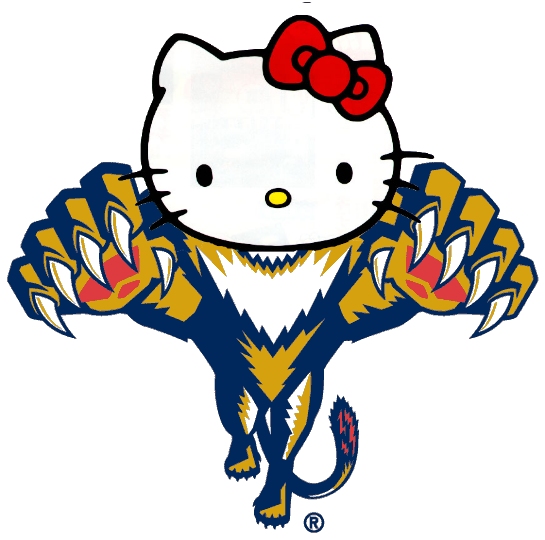
Tampa Bay Lightning

A scrawling blaze of wild electricity! What could be more exciting? Well, apparently Tampa thought a jagged forward-slash was. Oh, and could someone explain to me what the giant, needless circle behind the bolt is? Did they feel like they needed more geometry on their sweaters? Or maybe people would be confused what the logo was without a background? No, we got it. The Tampa Bay Zig-Zags, right? It looks like Flash's logo caught a cold.

Washington Capitals

Another pat on the back goes to Washington for ditching their old logo which prominently displayed the Capitol Building. I mean, nothing says hockey like a big government building, right? Except on their new logo, I can't help but find it ironic that their team's name, the Capitals, is in all lowercase letters. Hmm. Kudos for making the "L" look like a hockey stick as well. It should come in handy if your fans forget what sport you're playing. I can't forget to mention the secondary logo. As clever as it was to make an eagle look like the letter "W", it just looks like some kind of post-op bird that had his legs removed. He's got those wings, but the landing is going to be a little rough.

Next post: Central Divison.

Friday, July 31, 2009

Fuzzy Math

Let's rewind a few weeks to the start of the free-agency period. The most coveted free-agent available this year, Marian Hossa, shocks everyone and signs with the Chicago Blackhawks. In one fell swoop Hossa signed with his former team's rival (not surprising considering his track record), displaced his friend and former Blackhawks star Martin Havlat, and added to an already ballooning Chicago payroll.

Oh, but it's okay. Hossa got one of those crazy, new, front-loaded contracts that makes everything okay! Want me to explain? I'd love to!

Chicago signed Hossa to a 12 year deal worth $62.8 million. Ludicrous, but here's the catch; the contract is heavily front-loaded so even though Hossa will make nearly $8 million for the next seven seasons, his contract will drop to $4 million and less for the last 5 years. This averages Hossa's cap-hit to $5.167 million per season. In short, a team can only have about $57 million worth of contracts per season. So by giving Hossa this contract, they have around $3 million more in cap space for the first seven seasons than they would if Hossa's cap-hit matched his actual cash dollars.

Don't worry, the hard math is almost over and I'll get to the interesting stuff. Why is this contract so strange? Let's compare it to that of Eric Staal on my favorite team, the Carolina Hurricanes. Staal is a comparable player to Hossa in terms of offensive production. Staal is also signed to a long term deal and also for a lot of money. However, Staal's cash dollar amount starts at $6 million and goes up to $9.5 million at the end of the deal. This gives Staal a large cap-hit of $8.25 million. Here is the key difference; when Staal's contract expires he will be 32 and in the prime of his career. When Hossa's deal expires he will be 42 and ready for bingo (in hockey years that is).

The Hurricanes should be able to justify the steep cap hit in 2015 because Staal should still be putting up big numbers. Can Chicago justify wasting over $5 million in cap space on a guy who may not be nearly as productive?

This is where it gets interesting. There is an allegation that Hossa and the Blackhawks have a secret deal in place that Hossa will retire before the end of his contract, thereby preventing Chicago from having to pay him the low end of the contract in the future and also preventing them from wasting the cap space now. For Hossa and the Blackhawks it's a win-win. Get a guy in the prime of his career, pay him lots of money now, and take a smaller cap-hit by circumventing the rules of the CBA (the Collective Bargaining Agreement, in layman's terms, the rules).

Why stop there? They could have signed him to a 40 year deal, pay him $8 million for the first 10 seasons, then pay the league minimum of $500,000 for the last 30. His cap-hit would be $2.375 million and he could retire at the age of 40 and nullify the last 30 years of the contract. Well, that would be about as transparent as a Filet-O-Fish wrapper and since it is totally against the rules, they lessen the risk of getting caught by signing him to the contract he has now.

Well, the NHL thought something was rotten in Denmark anyway because they have launched an investigation of Hossa and Chicago's deal. If they are found guilty of malfeasance, Chicago faces a maximum penalty of $5 million and the loss of draft picks. I would imagine Hossa's contract would be declared null and void as well, thereby making him a free-agent. From there I'm sure Hossa and the Blackhawks could figure something out that didn't fly in the face of the rules.

So to tally it up; so far this summer Chicago has misfiled their RFA qualifying offers, unceremoniously fired their much loved GM, and potentially signed Marian Hossa to an illegal contract. Quite a bit of funk blowing around in the Windy City...

Monday, July 27, 2009

It Is Broke, So Fix It

There is an inherent problem with the NHL All-Star Game. It should be an exciting spectacle of high-talent, high-intensity hockey. The talent is high, but not always the intensity. Why? Because it's in the player's best interest (and that of the team he belongs to) to sandbag it. What incentive is there to play hard? Why risk injury? A Honda Pilot if you're named MVP? A little more bling for your trophy cabinet? Pretty insignificant when we're talking about multi-million dollar players who only lust for one, big trophy by the name of Lord Stanley's Cup.

Well, why not take a page from Major League Baseball and give the winning conference home ice advantage for the playoffs? Not only would that not sit well with hockey purists, it simply doesn't make sense for the NHL. Not a knock on baseball, but hockey is a full contact sport. In hockey, giving it your all means laying your body on the line every shift. Imagine this; Eric Staal goes all out, lays a full contact hit on an opposing player, and dislocates his shoulder. He's out for the season and for what? So divisional rival Washington can get home ice advantage and win the Cup? It doesn't make sense for hockey.

So how then? In what way do you bring out the intensity in the All-Star Game without risking a player's health? You don't. You can't and you don't. Part of the reason hockey is such an intense, uptempo sport is because there is that physical risk. Take it away and you lose the crux of the appeal.

Is it a lost cause then? Do we accept that the All-Star Weekend is a glorified breather for the players? After all, one of the best players in the game sat out the All-Star weekend (albeit due to "injury") and he lifted the big one over his head this summer. How can the NHL increase the appeal while maintaining as little risk as possible to the players? Simple; "John Kerry" the whole weekend and flip-flop the schedule. Make the All-Star Game itself the triumphant opening to the weekend and make the SuperSkills Competition the main attraction.

Seems counterproductive, right? Well, what is the All-Star Game for? It's supposedly to display the games greatest players and potentially entice more fans to watch the game. How does that work when those players are sandbagging it to prevent injury? It just ends up looking like Ice-Capades to the untrained eye. Do we really want a potential fan tuning into the All-Star game and thinking our beloved sport is boring? Not I.

So this flip-flop achieves what? Try to imagine this scenario. A guy/girl goes into work and says to his/her friends, "Did you see the NHL All-Star Game this weekend? There was this sweet tic-tac-toe pass on the game winning goal." Not exactly enthralling to a non-hockey fan. Okay, now try this one, "Did you see the NHL Super Skills Competition this weekend? This 6'9" guy hit a slap shot that was 105 miles an hour!" Which one are you more willing to tune into? The latter appeals to what American sports fans love so much about baseball; the stats. How fast can a player skate around the rink? How fast can he belt a slap shot? How fast can he break the targets? Not to mention the fact that there is a greatly reduced risk of injury in these events. It's all gravy.

Don't stop there either. Make more SuperSkills events that test other aspects of the game. Make the casual fan say, "Wow, I need to see that in a game!" It's better than, "This is what the best in the world has to offer? Boring!"

Friday, July 24, 2009

Psychics Wanted

I have a fun game for you to try out. Next time you are due for a raise, tell your boss to keep paying you the same amount, but in a year they can start paying you a salary of $2 million, because that's how much you'll be worth. Then report back to me how long it took for you to fit your belongings into a box.

Seems ludicrous, right? Well that's the way the NHL works.

The debate will never cease on how much a player should be paid, or how a team is overpaying for someone. Seriously, not even the greatest player in the world will escape without criticism for the number of Ben Franklin wallet photos he's walking around with. I'll give you an example; I read somewhere that Alexander Ovechkin may not deserve the money he's making, or the length of his contract, because he plays such a physical game that it's hard to tell how durable he'll be. Really? That's the argument? For this guy?

On the other hand, players today demand contracts that are older than middle schoolers. That means General Managers are playing a lot more Miss Cleo than they ever have. How do you know how good or bad a player will be in the year 2017? What if 6 years pass, the guy turns into a skating mascot and you're still paying him $6 million a year? Whoops. Sometimes, it turns out he was injured before you even signed him!

Players are investments. With an investment, the least that you want is to break even. Ideally, you get a steal. However, more often than not you're left wondering why you emptied your savings into webvan.com, and believe me, there will be more than one webvan.com lacing up his skates this October.

What it comes down to is spending wisely. Anytime you put your money into a hypothetical, it's a gamble. You just have to play the odds in any given situation. How has he played thus far in his career? Does he have upside, or has he reached his max potential? Do I really see him playing at age 42? Why is my 12 year old cousin blogging about how much of an idiot I am?

Life for a General Manager is hard. Remember how your mom used to criticize you for wasting all of your money on baseball cards or Ninja Turtles? Now imagine you are a GM and have a couple million moms, constantly scrutinizing every penny you spend. And, these moms aren't lovable-casserole-making-moms, they're annoying-fanboy-blogger-moms. Not a terribly nurturing bunch.

Remember, no NHL GMs are psychic (none that I know of), so maybe cut them some slack. Or maybe e-mail them the name of a good tarot card reader.

Wednesday, July 8, 2009

Explain This To Me Like I'm Five...

There's an episode of "The Office" where the character Oscar is trying to explain to the character Michael how his budget works using an allowance and a lemonade stand as a comparison. After the severely dumbed down explanation, Michael replies, "Okay, break it down in terms of, um... okay, I-I think I'm getting you..." How does this apply to the NHL? Let's just say some General Managers are acting a little Michael Scott-like in their understanding of money.

Let me start by saying I have the utmost respect for these men and the difficult jobs they do. That said, some of them are screwing their teams royally!

So, who's doing it wrong? Let's look at Philadelphia. They are flush with talent on both offense and defense. However, they had to go to Russia and bring back a problematic goaltender in order to afford someone who is considered a "starter." Then, they trade a boatload of talent for a highly paid, yet aging star in Chris Pronger. Not to mention the fact they are saddled with Danny Briere's $6.5 million dollar contract until 2015. That would be fine if Briere was worth that much.

Philly has almost $46 million committed to salaries for next season and the salary cap is likely to come down from this seasons cap of $56.8 million. Even if it didn't, that would mean the Flyers would need to find 3 forwards, 3 defenseman, and a starting netminder for $10.8 million.

Philadelphia was in the worst condition, until Chicago stole their thunder. How? Well, for starters, Chicago is already over the cap for this coming season. They'll need to find ways to shed salary and not lose key players before the season starts.

However, like Philadelphia, the Blackhawks' real problems lie in the future. Chicago has $43 million committed to salaries next season. 7 of their players become Restricted Free Agents next season, and 5 of them Unrestricted Free Agents. Among those players are Jonathan Toews, Patrick Kane, Andrew Ladd, and Duncan Keith. Heck, Toews and Kane alone will cost more than the $13.8 million in the cap space that's available for next season. Don't forget you have 10 other players to sign as well. Bet you're rethinking that $7.1 million contract you gave Brian Campbell last summer, right Dale Tallon?

The issue is a common one and a totally avoidable one; don't overpay for players. Pay a player their appropriate value. If you really want that player but they're asking for too much, don't sign them! Any team would love to have Marian Gaborik, but if I'm the Rangers, do I pay $7.5 million for a guy who gets injured more often than a hemophiliac rodeo clown?

When I was growing up my parents tried to teach me not to spend money on something that isn't worth it. I probably could have lived with a few less video games, but for the most part the lessons stuck. Maybe I should tell my parents to call some of the leagues GM's and give them some pointers...

Why does this matter? Why not let those teams mismanage their money? Because when a player gets an inflated contract, it ruins things for everyone. If Player X gets a $4 million contract, even though he deserves a $3 million contract, everyone else gets bumped too. To go back to an analogy for five year-olds, you can't give one child two scoops of ice cream and another, equally valuable kid one scoop. Unless of course you value your children differently...

It's a "buy first, ask questions later" mentality and some teams are going to feel the sting when the bill comes. It's only a matter of time until it hits the fan and GM's learn to rebuild through the draft (see Kings, Los Angeles or Blues, St. Louis for good examples) and not throw wads of money at UFA's (see Gainey, Bob). Unfortunately, you can't always expect your kids to make the right decisions the first time. Sometimes you have to watch them fall and hope they learn to get back up and not make the same mistake twice.